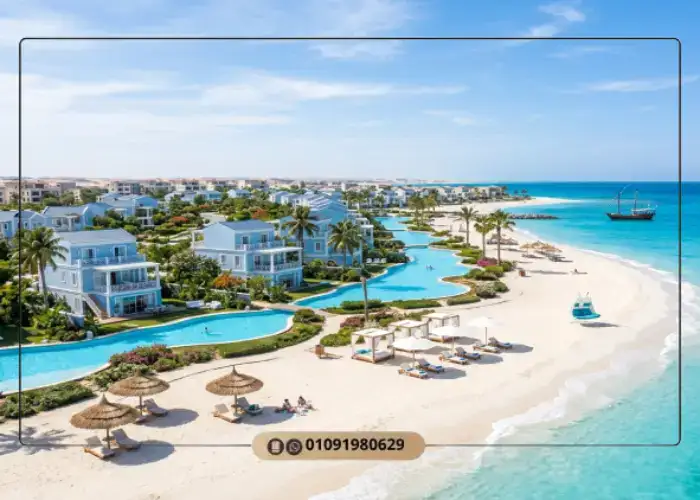
Coastal projects are the resort villages and beachfront developments along Egypt’s Mediterranean and Red Sea shores. They have been the fastest-growing segment of the market in recent years, driven above all by the expansion of the North Coast and the Ras El Hikma area, alongside Ain Sokhna, New Alamein and Hurghada. Real Estate Capsule currently lists 153 coastal projects, with unit prices from EGP 1,082,000 up to EGP 74,000,000 and an average around EGP 9 million.
How a coastal project differs from a residential compound
A coastal development is designed around the unit’s relationship to the sea rather than around daily living. That produces three characteristics you will not find inland:
- Terraced levels. Rows step upward as they move back from the beach so that rear rows retain a sea view. This makes the row number the single largest price variable in the entire project.
- Crystal lagoons. Artificial lagoons have become the standard way to compensate units set far back from the shoreline, and they materially lift the value of inner rows.
- Seasonal operation. Most amenities run at full capacity from May to September, which shapes both the maintenance charge and any realistic rental projection.
Contact us now for the best available coastal units and current payment plans
Unit types in coastal projects
| Unit type |
Typical sizes |
Notes |
| Chalets |
65 – 160 m² |
Most in demand and the easiest to resell |
| Twinhouses and townhouses |
180 – 280 m² |
Private garden at below-villa cost |
| Standalone villas |
250 m² and above |
Usually front rows or lagoon frontage |
| Hotel units |
50 – 120 m² |
Operated by a hotel manager for a share of revenue |
Popular coastal projects on Real Estate Capsule
Four questions to ask before buying a coastal unit
1. What is the row number and the level?
Ask this before you ask the price. The difference between row two and row six can exceed 30% of unit value, and the level is what actually determines whether you see the sea or the roof of the unit in front of you.
2. How many months a year do the amenities actually operate?
Ask specifically about the club, restaurants and pools. A village that runs four months a year is a fundamentally different asset from one that operates year-round, especially if you plan to rent.
3. What is the real distance in kilometres from the main road?
Phrases like “minutes away” are meaningless. Ask for the kilometre marker on the North Coast or Sokhna road — that is the only verifiable reference.
4. Is the beach exclusive to the project?
Some developments share a single beach with neighbouring projects, which affects peak-season crowding and resale value.
Frequently asked questions
Which North Coast area is best to buy in?
There is no single answer. The stretch from kilometre 90 to 130 is closer to Cairo and suits frequent use; Ras El Hikma and beyond offer clearer water and are seeing the largest current wave of development. The right choice depends on how many times a year you will actually use the unit.
Is a coastal unit a good investment?
It depends on three things: purchase price relative to neighbouring projects, the real rental season, and annual maintenance charges. Smaller units in projects with completed amenities are typically the most liquid on resale.
Why are maintenance fees higher on the coast?
Operating beaches, pools and landscaping in a coastal climate costs more than maintaining an inland compound. Fees are charged either as a percentage of unit price paid once, or annually per square metre.
Our team can match a coastal unit to your budget and how often you will use it